
Google has rolled out Private AI Compute, a new cloud-based processing system designed to bring the privacy of on-device AI to the cloud. The platform aims to give users faster, more capable AI experiences without compromising data security. It combines Google’s most advanced Gemini models with…
Black Friday Deal: Save Big on Avid Media Composer!
 Power and Precision for Every Editor
Avid Media Composer | Ultimate gives professionals the speed, precision, and creative tools to tell their best stories. Trusted by top film and TV editors, it combines ACE-certified tools with reliable media management to streamline every stage of production. Work faster and with complete confidence in every cut.

Seamless Collaboration Anywhere
Media Composer | Ultimate makes teamwork easy. Share bins, projects, and media with editors and producers locally or remotely through Avid NEXIS and MediaCentral. Collaborate across platforms—including Premiere Pro and Final Cut Pro—and keep everything in sync with Cloud Remote support

Advanced Tools to Elevate Every Story
With ScriptSync, PhraseFind, and Symphony included, you can find clips fast, color grade with precision, and finish projects with a professional polish. Media Composer supports HDR, 8K, and a wide range of formats while integrating seamlessly with Pro Tools and Avid hardware for stunning visuals and sound.
Chinese AI startup Moonshot outperforms GPT-5 and Claude Sonnet 4.5: What you need to know
A Chinese AI startup, Moonshot, has disrupted expectations in artificial intelligence development after its Kimi K2 Thinking model surpassed OpenAI’s GPT-5 and Anthropic’s Claude Sonnet 4.5 across multiple performance benchmarks, sparking renewed debate about whether America’s AI dominance is being challenged by cost-efficient Chinese innovation. Beijing-based…
The Sequence Radar #751: Last Week in AI: K2’s Brains, Lambda’s Capacity, ARR Gravitas
An amazing new model that pushes the boundaries of reasoning plus more deals and ARR news….
10% of Nvidia’s cost: Why Tesla-Intel chip partnership demands attention
The potential Tesla-Intel chip partnership could deliver AI chips at just 10% of Nvidia’s cost – a claim that represents a significant development in AI infrastructure that enterprise technology leaders cannot afford to ignore. On November 6, 2025, Tesla CEO Elon Musk stated publicly at the…
Upgrade Your Productions with TriCaster Bundles

NDI November is a month-long, free, virtual event series dedicated to exploring the power of NDI technology for modern live production. Throughout November 2025, we’ll bring together industry experts, vendors, dealers, and system integrators to deliver an in-depth look at NDI workflows and innovations shaping the future of IP-based production. Join Vizrt on November 11th at 3pm EST to see how Vizrt TriCasters can fit into your workflow
Register for FREE now and don’t miss this ultimate NDI event!

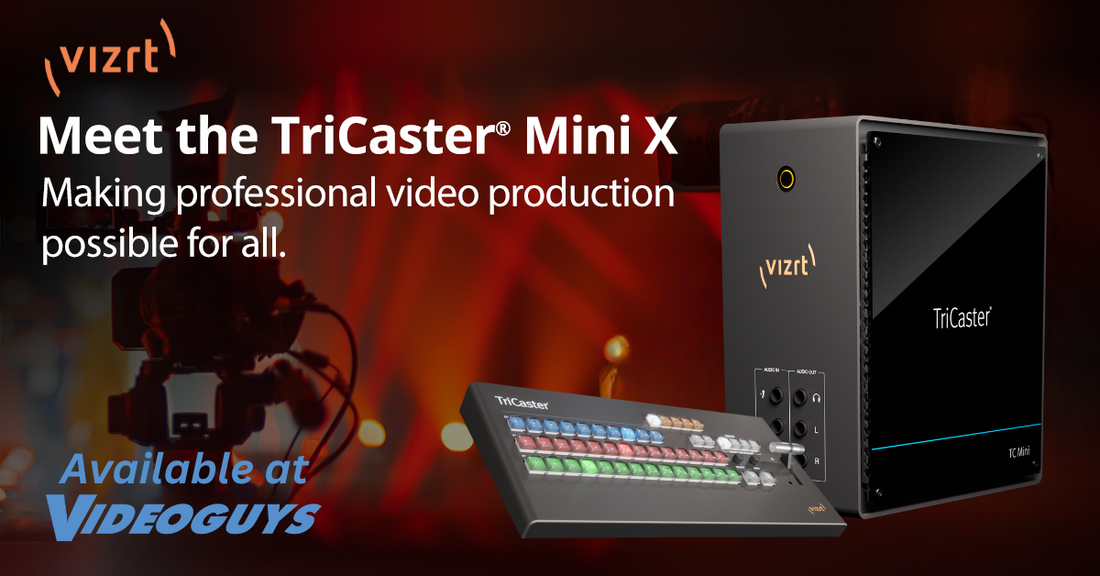
TriCaster Mini X gives producers at any level the freedom to create and share video wherever and whenever they want – truly demonstrating the power of software-defined visual storytelling. The ideal traveling partner for TriCaster Mini X, the Vizrt Control Surface, as a bundle provides studio-style control and a small footprint to deliver professional results…from the office, an event, or anywhere. Call Videoguys at 800-323-2325 for free tech advice!
 |
Save $600! The compact, plug-and-play design, intuitive layout mapped to the TriCaster Mini X interface, large backlit buttons, and premium T-Bar make this controller a perfect match for faster, more precise, and comfortable live production.
$9,995.00 PROMO Offer expires 12/31/25 |
|
Accessibility, Unlocked Bringing the possibilities of professional live video production to anyone with a story to tell – without vast investments in infrastructure. |
Flexibility, Attained Off-the-shelf HDMI devices connect directly to the Mini X in minutes creating professional-level productions without having to purchase any new equipment. |
Scalability, Achieved As part of the Vizrt ecosystem of products, users can take advantage of the many ways to scale up their productions to suit any need. |
|
Save $200! Easy to set-up and with hundreds of capabilities, TriCaster Mini X puts expert tools at your fingertips, without you having to be a production expert.
$7,995.00 PROMO Offer expires 12/31/25 |
 |

Take your production to the next level with TriCaster and Flex—the winning combination for professional live video workflows. Choose from five powerful configurations tailored to fit any production environment and save big when you bundle. Call Videoguys at 800-323-2325 for free expert advice, help finding the perfect setup, or to connect with a local integrator from our nationwide dealer network. Offer expires Dec 31st, 2025
|
A compact solution built for small to mid-sized productions with essential IP workflows.
$15,495.00 PROMO Offer expires 12/31/25 |
A scalable system designed for larger productions, offering 16 external inputs and UHD switching.
$20,995.00 PROMO Offer expires 12/31/25 |
An advanced platform with premium features like Live Call Connect, Live Story Creator, and real-time remote workflows.
$27,995.00 PROMO Offer expires 12/31/25 |
|
A rackmount system tailored for professional studios, supporting 8-channel switching with powerful automation.
$30,995.00 PROMO Offer expires 12/31/25 |
A rackmount system tailored for professional studios, supporting 16-channel switching with powerful automation.
$32,995.00 PROMO Offer expires 12/31/25 |
A high-performance tower system built for enterprise-level productions, delivering 16-channel switching, UHD capabilities, and maximum expandability.
$32,995.00 PROMO Offer expires 12/31/25 |


Learn More About TriCaster + Flex Bundles Here
Headings: Semantics, Fluidity, and Styling — Oh My!
A few links about headings that I’ve had stored under my top hat.
Headings: Semantics, Fluidity, and Styling — Oh My! originally published on CSS-Tricks, which is part of the DigitalOcean family. You should get the newsletter….
The universal tool calling protocol for agentic AI
Discover UTCP: the open, flexible alternative to MCP. Build agentic AI that scales natively, securely, and without middleware overhead….
AI agents: 5 lessons for getting it right
Based on case studies, industry examples, and lessons from practice, here are five lessons for deploying AI agents successfully….